Our Moon, laid over NASA’s.
Moon Tonight is a new tab that shows the Moon as it is tonight, from where you are. To be sure it’s the real Moon and not just a pretty one, we photograph ours at twelve hours of 2026 and lay each over NASA’s own frame for the same hour.
These are the plates. Flick between them, the way astronomers compared photographs of the sky: anything wrong would jump.
Coming soon to Chrome, Edge and Firefox. Free, no account.
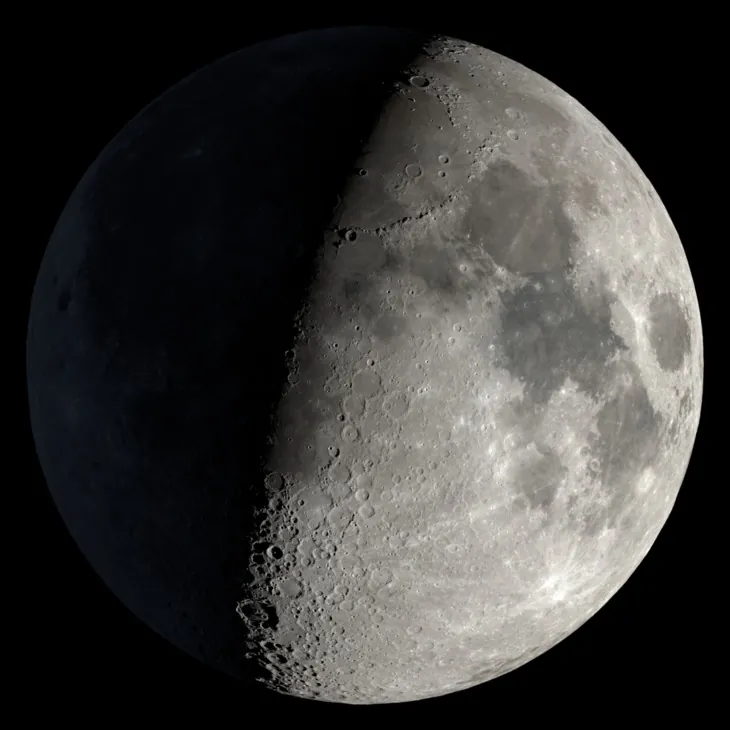
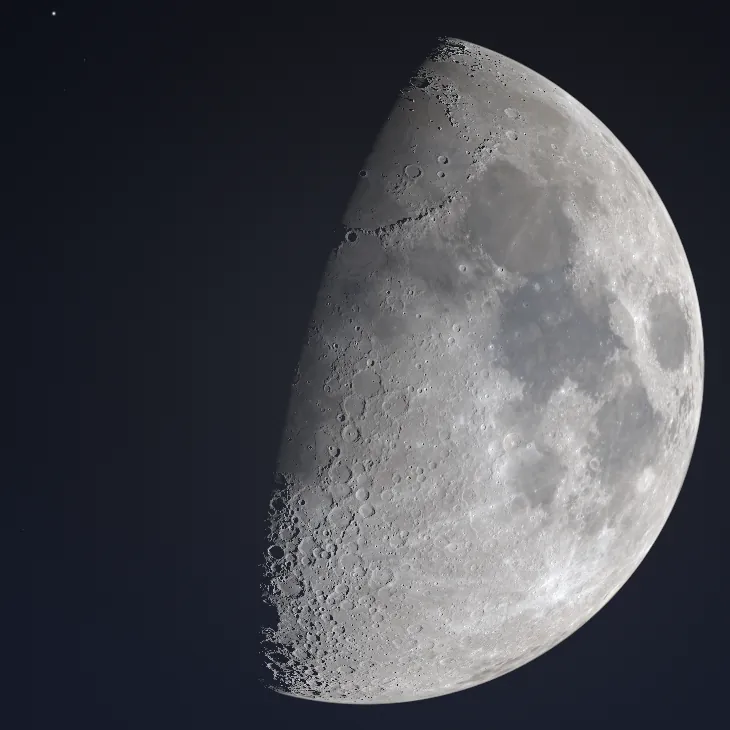
27 January 2026, 04:00 UTC
Waxing gibbous, 61% lit, 8.3 days after new Moon, 369,463 km away
Twelve plates of 2026
Each Moon is drawn at its size that hour. On 4 January it was 365,658 km away; a week later, 402,399 km, and nearly a tenth smaller.
What each plate has to pass
A test in Moon Tonight’s own code renders our Moon north up, as NASA’s frames are, at the size of NASA’s disc, and measures it against NASA’s. It runs before every release. These are the numbers it logged for plate 6.
- The lit part lands in the same place
- How much of the lit area the two plates share, and how far apart their centres are. A Moon on the wrong night, lit from the wrong side or the wrong size fails here.
- 94.2% shared needs 90%
- 2.0% of the radius apart under 4%
- The craters line up
- The fine detail inside the disc, craters and the edges of the seas, compared point by point. A map turned or tipped the wrong way, or the Moon’s wobble (libration) left out, fails here.
- 0.67 correlation needs 0.45
- And a mirrored Moon doesn’t
- The same render, flipped left to right, has to match far worse, so the test can tell a real match from a lucky one.
- 0.00 mirrored under 0.20
The rules it’s built by
- Only the Moon. No to-do lists, quotes, timers or photographs. The time, your own search, and if you want them, the weather and your sites.
- True, not decorative. The phase, the lit side, the tilt, the size and eclipses are worked out for your place and moment, and never nudged to make a nicer picture.
- Nothing leaves your computer unless you switch on the weather. Your place comes from your time zone. No account, no analytics.
- No warnings at install. Anything that needs a permission asks for it when you switch it on.
- In 25 languages, right to left where the language reads that way.
Tonight’s Moon lives at moonfromhere.com
The live Moon from your place, the ten looks, and what the Moon was doing on any night from 1900 to 2100.
NASA’s frames: Moon Phase and Libration, 2026, by Ernie Wright, NASA’s Scientific Visualization Studio. Moon Tonight draws its Moon from the maps of NASA’s Lunar Reconnaissance Orbiter.